 EduNavigator AIDemo build · fictional business, simulated data
Answers with receipts: the explanation and the data, in one reply.
A study-abroad advisor that grounds explanations in verified sources and derives program tables from a live catalog — with the admin console that keeps both honest.
Live demos are password-gated — request access via WhatsApp, takes a minute.
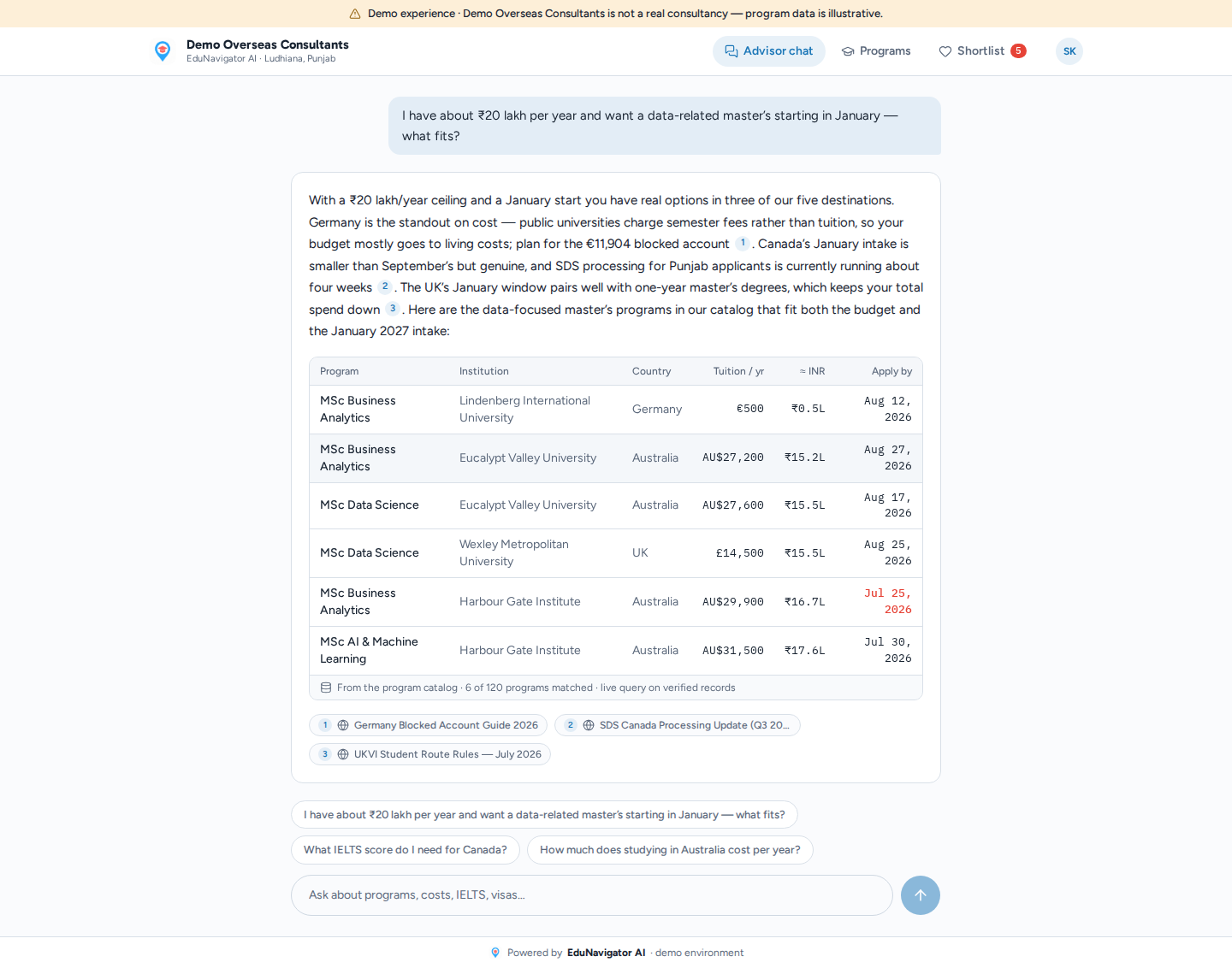 Numbered citations open the source passageLive query — tuition in local currency and ₹L“6 of 120 programs matched · live query on verified records”
The challenge
Study-abroad advice fails in two directions: fluent prose with invented deadlines, or accurate spreadsheets nobody reads. Students need the explanation and the rows, together, with provenance.
The consultancy’s credibility depends on freshness — a tuition figure verified last month may already be wrong, so maintenance has to be a visible workflow, not a promise.
The solution — three decisions
The hybrid answer is the product
One response streams a grounded explanation with numbered citations, then a table captioned “6 of 120 programs matched · live query on verified records.” The table is derived at runtime — it cannot disagree with the catalog.
One dataset, two apps
Student explorer, chat answers, and admin catalog manager all read the same shared data module. Editing a record in admin is editing what the assistant says.
Punjab-market authenticity
Tuition always shows the ₹-lakh figure students budget in, IELTS bands, blocked-account and SDS vocabulary — and the admin runs on IST.
How it works
Flow diagram: the inputs listed first feed into the EduNavigator engine engine in the middle, which produces the outputs listed last.
In
EduNavigator engine
Out
The demo implements this shape end to end with a simulated service layer — the “extend for production” section below lists what swaps in for live deployment.
Product tour
What the demo shows
- Token-streamed answers with tap-to-open citation dialogs
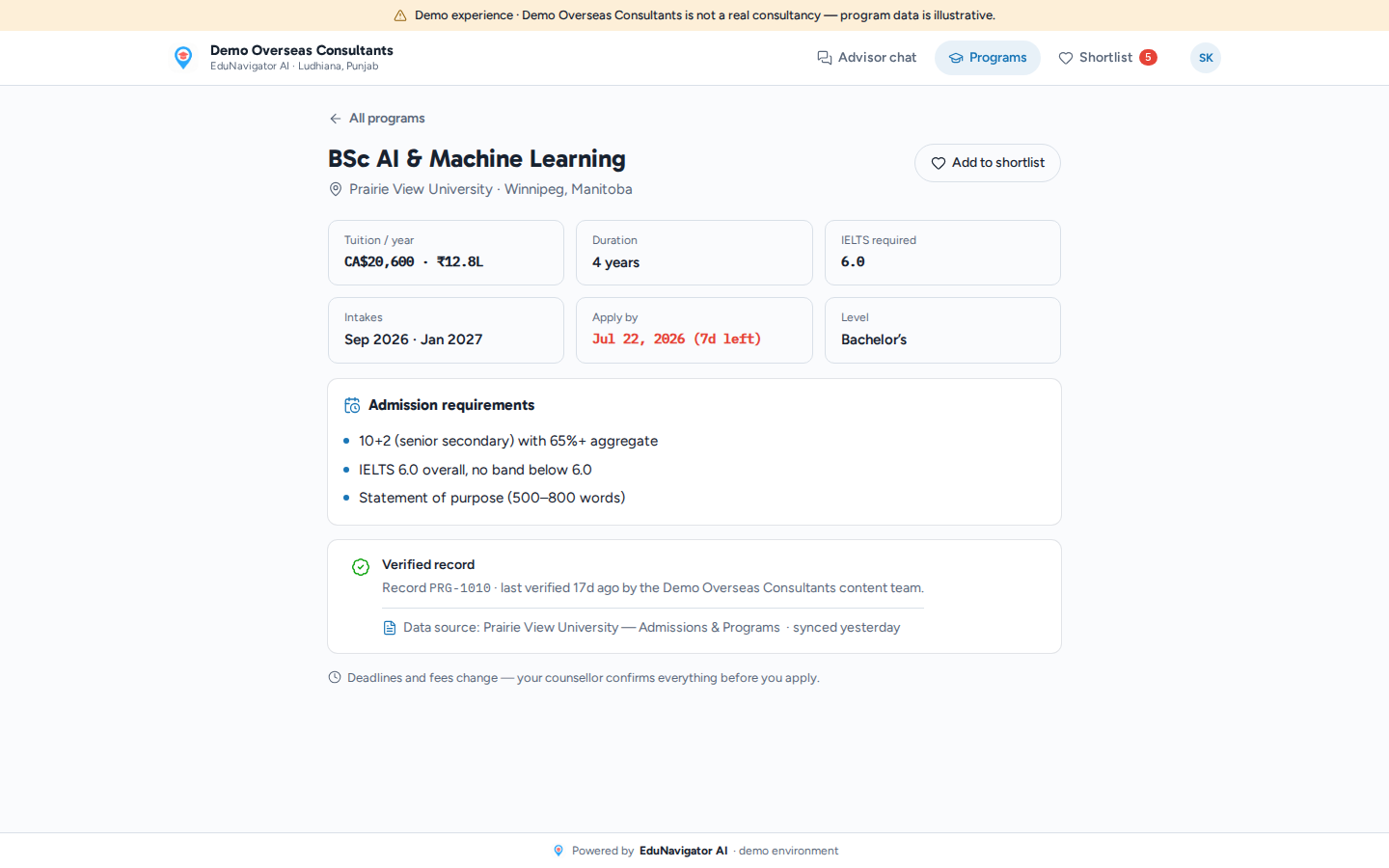
- The explorer filtering 120 programs by country, budget (₹L), and intake — live
- Deadlines computed forward from today, with urgency chips under 14 days
- Catalog records edited and re-verified in an admin drawer
Under the hood
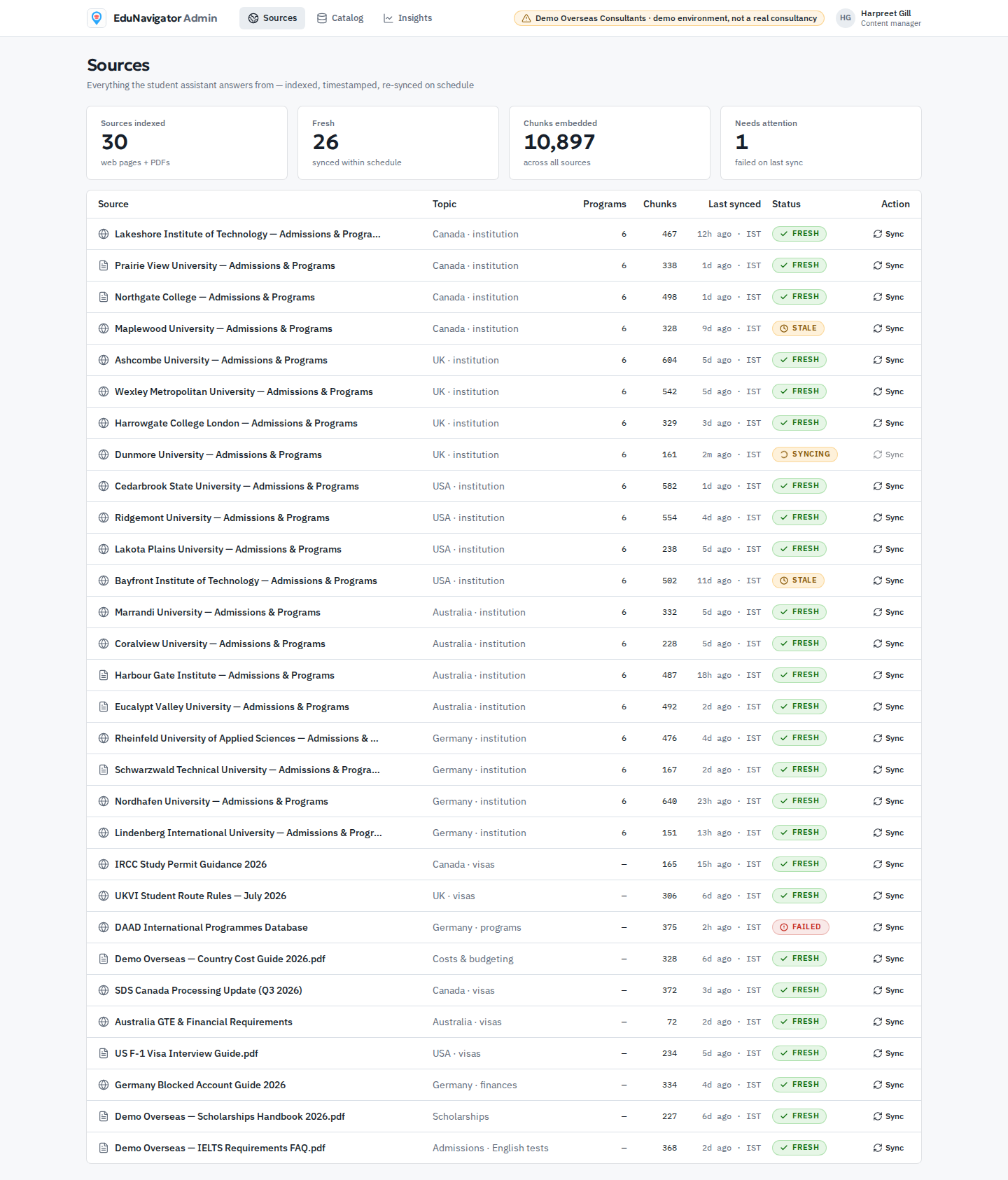
- A single seeded catalog module (20 fictional institutions, 120 programs, 30 sources) duplicated byte-for-byte across both apps
- Answer tables are runtime filters over that catalog — consistency by construction, not by copy-paste
- Admin counts reconcile by design: KPIs are computed from the same rows the tables render
- Two deliberately different shells: consumer top-nav for students, Stripe-style console for counsellors
Built as a demonstration — on purpose.
Demo Overseas Consultants, Ludhiana is fictional and labeled as a demo on every screen. Nothing here is presented as client work: no client names, no outcome metrics, no testimonials. The proof is the running product — open the live demo above (password on request) and check every claim.
What I’d extend for production
- Real text-to-SQL over a Postgres catalog with query guards
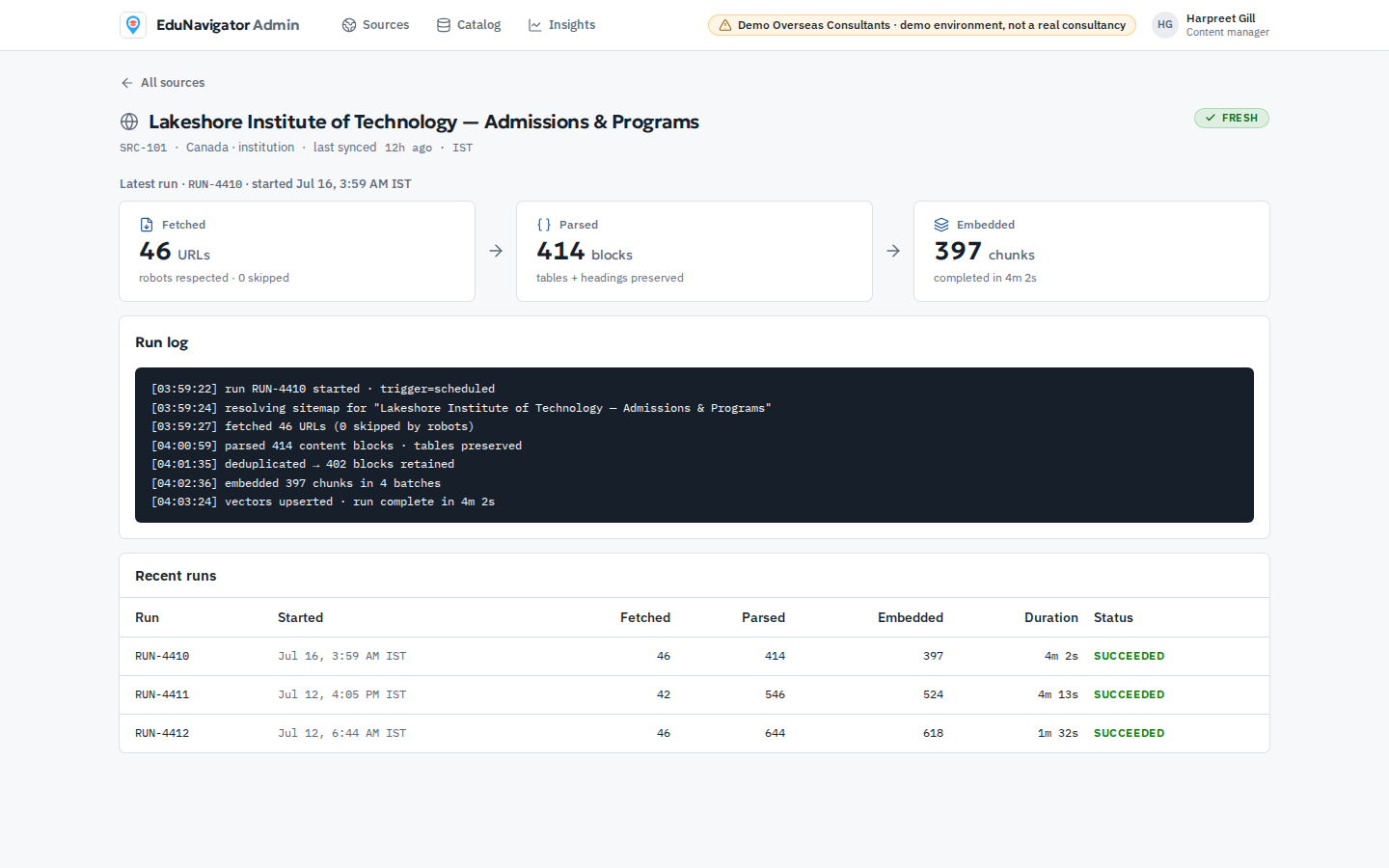
- Scheduled source re-crawls with diff-based verification queues
- Counsellor handoff when the assistant’s confidence drops